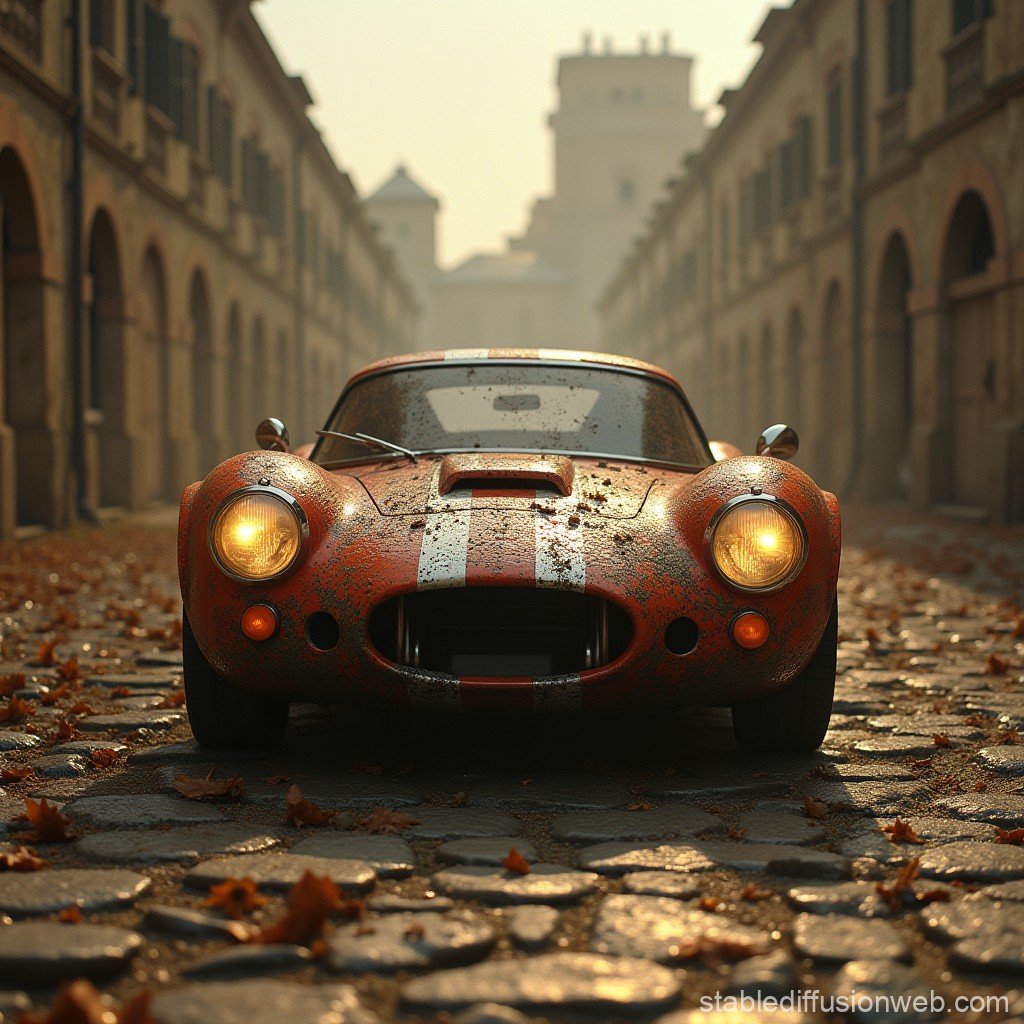
Imagine a world where car design isn't limited by countless hours of manual sketching or the sheer expense of physical prototypes. A world where you can conjure a bespoke vehicle, perfectly tailored to a fleeting idea, within moments. This isn't science fiction anymore. Understanding Random Car Generation Mechanics is the key to unlocking this future, leveraging the incredible power of AI to drive automotive creativity into uncharted territory. By 2025, these AI-powered tools became indispensable, not just for designers and marketers, but for anyone with a passion for pushing the boundaries of what a car can be.
At a Glance: AI Car Generation Explained
- What it is: AI systems, primarily using generative adversarial networks (GANs) and diffusion models, create unique, realistic vehicle designs.
- Why it matters: Drastically reduces design and production time (up to 70%), boosting engagement and opening new creative avenues.
- Core Technologies: Leverages advanced AI techniques like style transfer, parametric customization, Neural Radiance Fields (NeRFs), and real-time ray tracing.
- Key Applications: Rapid prototyping for designers, personalized marketing campaigns, immersive virtual showrooms, and dynamic social media content.
- Advanced Features: Platforms offer consistent multi-frame animations, multi-scene rendering, and custom AI training for specific brand aesthetics.
- Ethical Focus: Prioritizes design patents, automated watermarking, and bias mitigation to ensure responsible innovation.
The Dawn of Digital Design: Moving Beyond Manual Blueprints
For decades, car design was an artisanal craft, a painstaking process of concept sketches, clay models, and iterative refinements. It was slow, expensive, and often bottlenecked by human limitations. Then came AI. The shift wasn't gradual; it was a revolution. Studies reveal that AI-generated content can slash production time by a staggering 70% and significantly boost engagement rates across the board. This isn't about replacing human ingenuity; it's about amplifying it, allowing designers to focus on vision while AI handles the heavy lifting of iteration and visualization.
The core of this transformation lies in sophisticated machine learning. Think of AI as an endlessly curious apprentice, constantly learning from vast datasets of existing vehicles, understanding the subtle nuances of proportion, style, and engineering that make a car appealing and functional. What started with simple preset templates has evolved into complex systems capable of generating truly original concepts with breathtaking realism.
Beneath the Hood: How AI Crafts Your Dream Machine
The magic behind AI car generation isn't a single trick; it's a symphony of cutting-edge technologies working in harmony. Each advancement builds upon the last, pushing the boundaries of what's possible, from basic shapes to photorealistic, physics-aware simulations.
The AI Toolbox: Core Technologies Driving Innovation
- Generative Adversarial Networks (GANs): The Creative Duel
Imagine two AIs locked in a constant competition: one, the "Generator," tries to create new car designs, while the other, the "Discriminator," tries to tell if the design is real or fake. The Generator keeps improving its output based on the Discriminator's feedback, leading to incredibly realistic and novel designs that can fool even the most discerning eye. This adversarial training is crucial for producing original concepts that respect the unwritten rules of automotive aesthetics. - Diffusion Models: Refining Art from Noise
Diffusion models operate on a different principle. They start with pure noise and iteratively refine it, slowly "denoising" the image into a coherent, detailed car design. It's like watching a sculptor reveal a masterpiece from a block of marble, guided by millions of data points on car shapes, textures, and lighting. These models are particularly adept at generating highly detailed and aesthetically pleasing visuals, often with a remarkable sense of coherence. - Neural Radiance Fields (NeRFs): Bringing 3D to Life from 2D
One of the biggest leaps has been with NeRFs. Traditionally, creating 3D models was time-consuming. NeRFs can construct a full, rotatable 3D model of a car from just a few 2D images. This means you can generate a concept car and instantly see it from any angle, under various lighting conditions, without needing a dedicated 3D artist to model it from scratch. It's a game-changer for rapid visualization and iteration. - Style Transfer: Mastering Any Aesthetic
Want a car that looks like it rolled out of a retro-futuristic movie, or perhaps a cyberpunk racer? Style transfer allows AI to apply specific design languages or artistic styles to a generated vehicle. It analyzes the aesthetic elements of a reference image (e.g., the sleek lines of a classic sports car, the ruggedness of an off-roader) and applies them intelligently to a new design, creating visually cohesive and exciting concepts. - Parametric Customization: Precision at Your Fingertips
This is where user control comes in. AI car generators aren't just spitting out random images; they allow for deep customization. Via intuitive sliders or text prompts, you can adjust specific elements like wheelbase length, headlight shape, body lines, spoiler size, or even the aggressiveness of the grille. This gives designers and enthusiasts unprecedented control over the generated output, fine-tuning every detail to their vision. - Physics-Aware Rendering: Beyond Looks, Into Performance
It's not just about how a car looks, but also how it performs. Modern AI can simulate performance aspects, allowing designers to visualize how a new body shape might interact with aerodynamics in a virtual wind tunnel or how it might fare in a simulated crash test. This integration of physics into the design process ensures that AI-generated concepts are not just visually appealing but also practically viable. - Real-Time Ray Tracing: Hyper-Realistic Materials
For photorealistic renders, real-time ray tracing is essential. This technology accurately simulates how light interacts with surfaces, allowing AI to instantly render materials like metallic paints, brushed aluminum, carbon fiber, or glossy finishes with incredible fidelity. The result is visuals so lifelike, it's hard to distinguish them from real photographs.
From Concept to Consumer: AI's Transformative Automotive Applications
The implications of AI car generation span the entire automotive value chain, from the initial sketch to the final sale, and even how enthusiasts interact with their favorite brands.
Empowering Designers: The Rapid Prototyping Revolution
For automotive designers, AI is less a competitor and more a super-powered assistant. Imagine being able to generate over 100 distinct design variants of a concept car in mere minutes, each exploring a different aesthetic direction or structural configuration. This dramatically accelerates the ideation phase, freeing designers from repetitive tasks and allowing them to focus on high-level creative direction.
Take, for instance, a hypothetical "Toyota 2025 concept division" (as seen in context research) leveraging AI for crowdsourcing ideas. This approach allows designers to quickly generate diverse concepts, then use AI to refine user-submitted ideas or blend elements from multiple successful designs, making the creative process more collaborative and efficient. The ability to iterate at speed means more innovative designs can reach maturity faster than ever before.
Redefining Marketing & Sales: Hyper-Personalization at Scale
The impact on marketing and sales is perhaps even more immediate and tangible. AI car generation is allowing brands to move beyond generic campaigns to deliver content that resonates deeply with individual customers.
- Personalized Ads: Gone are the days of one-size-fits-all advertisements. AI can dynamically generate video ads showing a customer-specific car configuration, perhaps based on their browsing history or expressed preferences. Imagine seeing an ad for a car in your preferred color, with your desired trim level, driving through an environment you frequent. This level of personalization dramatically increases engagement.
- Virtual Showrooms: The traditional dealership model is evolving. Virtual showrooms, powered by AI, allow prospective buyers to explore an infinite array of color, wheel, and trim combinations in 3D. They can walk around the car, open doors, and even "sit inside" a vehicle that literally doesn't exist yet, all from the comfort of their home. This interactive experience significantly enhances the buying journey.
- Social Media Content: Keeping social media feeds fresh and engaging is a constant challenge. AI can rapidly generate a steady stream of diverse and visually stunning posts, animations, and short videos featuring different car models and configurations, tailored to current trends or specific campaigns. This ensures brands remain top-of-mind with dynamic, eye-catching content.
- Video Campaigns: From creating initial storyboards to generating full, high-fidelity sequences for advertisements, AI streamlines video production. It can render specific scenarios, vehicles, and environments, reducing the need for costly physical shoots and lengthy post-production processes, dramatically cutting down the time to market for new campaigns.
Beyond the Basics: Advanced Platforms and Their Edge
While the foundational AI models are powerful, dedicated platforms integrate these technologies into user-friendly interfaces, adding layers of sophisticated features that cater specifically to the automotive industry's needs. Platforms like Reelmind.ai exemplify this advanced integration, pushing the boundaries of what's possible.
These specialized tools go beyond static image generation, offering comprehensive AI video generation and advanced image editing capabilities. Here's what sets them apart:
- Customizable 3D Renders: Not just 2D images, but fully customizable 3D models that can be manipulated, rotated, and viewed from any angle.
- Dynamic Ads & AI-Assisted Car Configurators: These are not just concepts but fully functional tools that integrate directly into marketing workflows, allowing for real-time adjustments and personalized customer experiences.
- Consistent Multi-Frame Sequences for Animations: A critical feature for video. The AI ensures that a generated car retains its identifiable features, proportions, and style across multiple frames, crucial for smooth, believable animations and video content. Reelmind's "Consistent Character" technology specifically addresses this, ensuring your AI-generated car doesn't suddenly change its design mid-animation.
- AI Fusion of Multiple Reference Images: Users can provide several reference images, and the AI will intelligently blend their design elements to create a novel concept that incorporates the best of each.
- User-Trainable Models: This is a significant advantage for brands. You can "train" the AI on your specific brand's design language, historical models, and future concepts. This fine-tunes the AI to generate new designs that are perfectly aligned with your brand identity, ensuring consistency and brand integrity.
- "Multi-Scene" Feature: Imagine generating the exact same car model, with identical lighting and proportions, rendered in completely different environments—an urban cityscape, a rugged off-road trail, or a sleek racetrack. This multi-scene capability is invaluable for showcasing a vehicle's versatility and appeal in diverse contexts without needing separate photoshoots.
The impact of such platforms is measurable. One case study highlighted how Reelmind reduced an automaker's ad production timeline from a staggering six weeks down to a mere four days. This kind of efficiency isn't just a cost-saver; it allows brands to be more agile and responsive in a fast-paced market.
Your Turn: Crafting Custom Cars with AI
Feeling inspired? The good news is you don't need to be an AI engineer to start generating your own dream cars. Platforms like BasedLabs.ai have democratized access to these powerful tools, making the process intuitive and fun. Here's a typical workflow:
- Specify Car Parameters: Think about the fundamental characteristics of the vehicle you envision. Most generators offer filters to get you started:
- Era: Do you want a 'Modern' supercar, a 'Classic' cruiser, or something 'Futuristic'?
- Make/Model (Optional): You can often specify a particular brand (e.g., 'Tesla', 'Ferrari') or even a model (e.g., 'Model S', 'F40') to influence the AI's starting point.
- Artistic Style: Decide on the aesthetic. Do you want a 'photorealistic' render, a 'cartoonish' interpretation, or perhaps something in an 'anime' style?
- Add Custom Modifications with a Prompt: This is where your creativity truly shines. Use a text prompt box to describe detailed modifications and scene settings. Be as specific as possible.
- Vehicle Customization: "matte black paint job," "lowered suspension," "widebody kit," "chrome wheels," "gull-wing doors," "sleek aerodynamic spoiler."
- Environment & Lighting: "golden hour lighting," "night scene with neon glow," "raining on a city street," "desert road at sunset," "volcanic landscape."
- Camera Angle: "low angle shot," "bird's eye view," "side profile," "front three-quarter view."
- Combine them: "A modern electric sports car, matte black paint, extreme widebody, chrome wheels, at night in a rainy Tokyo street, neon reflections, cinematic low angle shot."
- Generate and Refine: Click 'Generate' and watch the AI bring your vision to life.
- The generator will produce slightly different results each time, even with the same prompt, allowing you to explore variations.
- Review the output. If it's not quite right, adjust your parameters or modify your text prompt for more specific instructions. Maybe the "matte black" wasn't matte enough, or the "neon glow" was too subtle. Refine, then generate again until you're satisfied.
- Once you have a design you love, you can typically download the images in your preferred resolution, often up to stunning 4K.
- Don't forget to save your favorite prompts! Many platforms allow you to save them, making it easy to revisit and iterate on successful designs.
Ready to give it a try and see what you can create? Try our random car generator and let your imagination take the wheel.
Navigating the Digital Frontier: Ethics, Legality, and Responsible AI
As with any powerful new technology, AI car generation brings with it important ethical and legal considerations. Ensuring responsible deployment is paramount for sustained innovation and trust within the industry.
Protecting Creativity: Design Patents & IP
With AI capable of generating novel designs at unprecedented speed, the question of ownership and intellectual property (IP) becomes critical. OEMs (Original Equipment Manufacturers) are proactively working to patent AI-assisted designs, recognizing the need to protect their investments in these advanced tools and the unique outputs they produce. The legal frameworks around AI-generated IP are still evolving, but establishing clear ownership is a priority for preventing unauthorized use and fostering continued innovation.
Trust & Transparency: Watermarking AI Content
To combat potential misuse or misrepresentation, automatic watermarking of AI-generated content is becoming a standard practice. This embedded metadata or visual marker clearly identifies the image or video as AI-generated. This helps maintain transparency, prevents content from being passed off as human-created, and allows for easier tracking of its origin, addressing concerns about deepfakes and deceptive marketing.
Building a Diverse Future: Bias Mitigation
AI learns from the data it's fed. If the training data primarily consists of homogenous designs (e.g., mostly sports cars from Western manufacturers), the AI might inadvertently perpetuate biases, leading to a lack of diversity in its output. Bias mitigation involves deliberately training these tools on diverse datasets that include a wide range of vehicle types, cultures, historical periods, and design philosophies. This proactive approach ensures that AI car generators foster a future of inclusive and varied design, preventing homogenized outputs and encouraging truly global creativity.
Demystifying AI Car Generation: Your Questions Answered
Let's address some common queries and clear up any misconceptions about this exciting technology.
Is AI just copying existing cars?
Absolutely not. While AI learns from vast datasets of existing vehicles, its primary function isn't to replicate. Instead, it identifies patterns, design principles, and aesthetic relationships to then synthesize entirely new, original concepts. Think of it less like a photocopier and more like an artist who studies art history to develop a unique personal style. The goal is to innovate, not imitate, producing designs that often surprise even experienced human designers.
How realistic are these AI-generated cars?
Incredibly realistic. Thanks to advancements like Neural Radiance Fields (NeRFs) and real-time ray tracing, AI can generate photorealistic 3D models and renders that are almost indistinguishable from actual photographs or high-end CGI. Materials like metallic paints, carbon fiber, and glass are rendered with astonishing fidelity, and lighting conditions can be precisely controlled to create incredibly convincing scenes.
Can AI replace human designers?
No, AI is a powerful tool, not a replacement for human creativity. It's an accelerator, an assistant that can handle the repetitive, iterative tasks, allowing human designers to focus on the strategic, visionary, and emotionally resonant aspects of design. AI provides a nearly limitless canvas for exploration, but the human touch—the intuition, the cultural understanding, the storytelling—remains essential for truly groundbreaking automotive design.
What's the learning curve for these tools?
The learning curve is surprisingly gentle for basic generation. Most platforms are designed with intuitive interfaces, often relying on simple text prompts and sliders. While mastering advanced features like custom AI training or precise parametric controls requires more practice, getting started with generating unique car concepts is accessible to anyone with an idea and a willingness to experiment. The trend is towards making these powerful tools increasingly user-friendly.
The Road Ahead: Embracing AI for Limitless Automotive Imagination
The landscape of automotive design and marketing is undergoing a seismic shift, and Understanding Random Car Generation Mechanics is at the heart of it. We've moved from a world of physical constraints and lengthy development cycles to one of digital fluidity and instant iteration. AI isn't just a trend; it's a foundational technology that is reshaping how vehicles are conceived, developed, and presented to the world.
For designers, it's a co-pilot that expands their creative horizons, offering unparalleled speed and flexibility. For marketers, it's a catalyst for hyper-personalized, engaging content that truly connects with audiences. And for enthusiasts, it's a gateway to bringing their wildest automotive dreams to life. As AI continues to evolve, we can only anticipate more sophisticated, intuitive, and astonishing capabilities. The future of car design is limited only by our collective imagination, and with AI at the wheel, that imagination is truly limitless.